Aachen, August 20, 1997
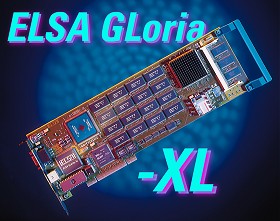 ELSA announces a new cutting-edge graphics board
for the most demanding tasks in visualization and CAD. The new
GLoria board equips any modern PC with high-end workstation
graphics performance. GLoria-XL is capable of displaying
even large textures with ultra-high resolutions in flicker-free
TrueColor at the highest speeds. The latest addition to the popular
GLoria series of graphics boards supports 3D standards
such as OpenGL, HEIDI and Direct3D. Together with the special
ELSA drivers, this 3D support provides optimized performance for
power-hungry 3D applications such as Softimage 3D, Pro/ENGINEER,
Pro/MECHANICA, AutoCAD, Autodesk Mechanical Desktop, LightWave
3D, 3D Studio MAX/VIZ, MicroStation95, MicroStation Modeler, I-DEAS,
Solid Edge, Lightscape, WorldToolKit, dVISE, CA Unicenter TNG,
SolidWorks, to name but a few.
ELSA announces a new cutting-edge graphics board
for the most demanding tasks in visualization and CAD. The new
GLoria board equips any modern PC with high-end workstation
graphics performance. GLoria-XL is capable of displaying
even large textures with ultra-high resolutions in flicker-free
TrueColor at the highest speeds. The latest addition to the popular
GLoria series of graphics boards supports 3D standards
such as OpenGL, HEIDI and Direct3D. Together with the special
ELSA drivers, this 3D support provides optimized performance for
power-hungry 3D applications such as Softimage 3D, Pro/ENGINEER,
Pro/MECHANICA, AutoCAD, Autodesk Mechanical Desktop, LightWave
3D, 3D Studio MAX/VIZ, MicroStation95, MicroStation Modeler, I-DEAS,
Solid Edge, Lightscape, WorldToolKit, dVISE, CA Unicenter TNG,
SolidWorks, to name but a few.
The GLoria-XL's memory equipment of up to 56 MBytes (!) can be called impressive. The board comes with 16 Mbytes of VRAM display memory and another 24 MBytes of 3D memory, which can be expanded to 40 MB. By using a 48-bit local buffer interface, the ELSA board allows the simultaneous use of front and back buffer functions as well as additional 3D features in one cycle. Thanks to a local buffer of this size, a full 112 bits per pixel can, for the first time, be addressed in each memory access, resulting in considerable performance gains in complex 3D applications.
Besides the memory, the processor equipment consists of top-class components as well: Two graphics chips build the heart of the GLoria graphics board. The combination of the GLINT MX graphics processor and the GLINT Delta 3D coprocessor from 3D specialist 3Dlabs provides the graphics accelerator with an ample amount of graphics power. Extreme processor performance like this is needed to calculate the 3D functions of modern visualization programs like hardware texture MIP mapping, anti-aliasing, fogging, overlay, stenciling and alpha planes in real time.
As expected from a professional graphics board, the GLoria-XL has been optimized for the operation under Windows NT 4.0. Under Windows NT, multi-screen operation is possible, even with 16:10 monitors like the ECOMO 24H96. GLoria-XL supports Z-buffering and double buffering resolutions up to 1920 x 1200 pixels in HiColor. 1600 x 1200 pixels are displayed even in TrueColor at a flicker-free 84-Hz refresh rate.
GLoria-XL will be available in October. Detailed information is available on the Internet at http://www.elsa.com.
ELSA AG is a privately-owned company based in Aachen, Germany, with subsidiaries in San Jose, California, and Taipei, Taiwan. Founded in 1980, ELSA has built up a world-renowned reputation for applying advanced engineering expertise to computer graphics and data communications products. Technological competence, German standards of quality, path-finding products and services backed up by excellent support: these are factors which firmly place ELSA at the forefront of the market today.
The ELSA logo is a registered trademark of ELSA AG. All other trademarks and registered trademarks previously cited are hereby acknowledged and recognized.